

Good morning!
It’s Friday, October 17.
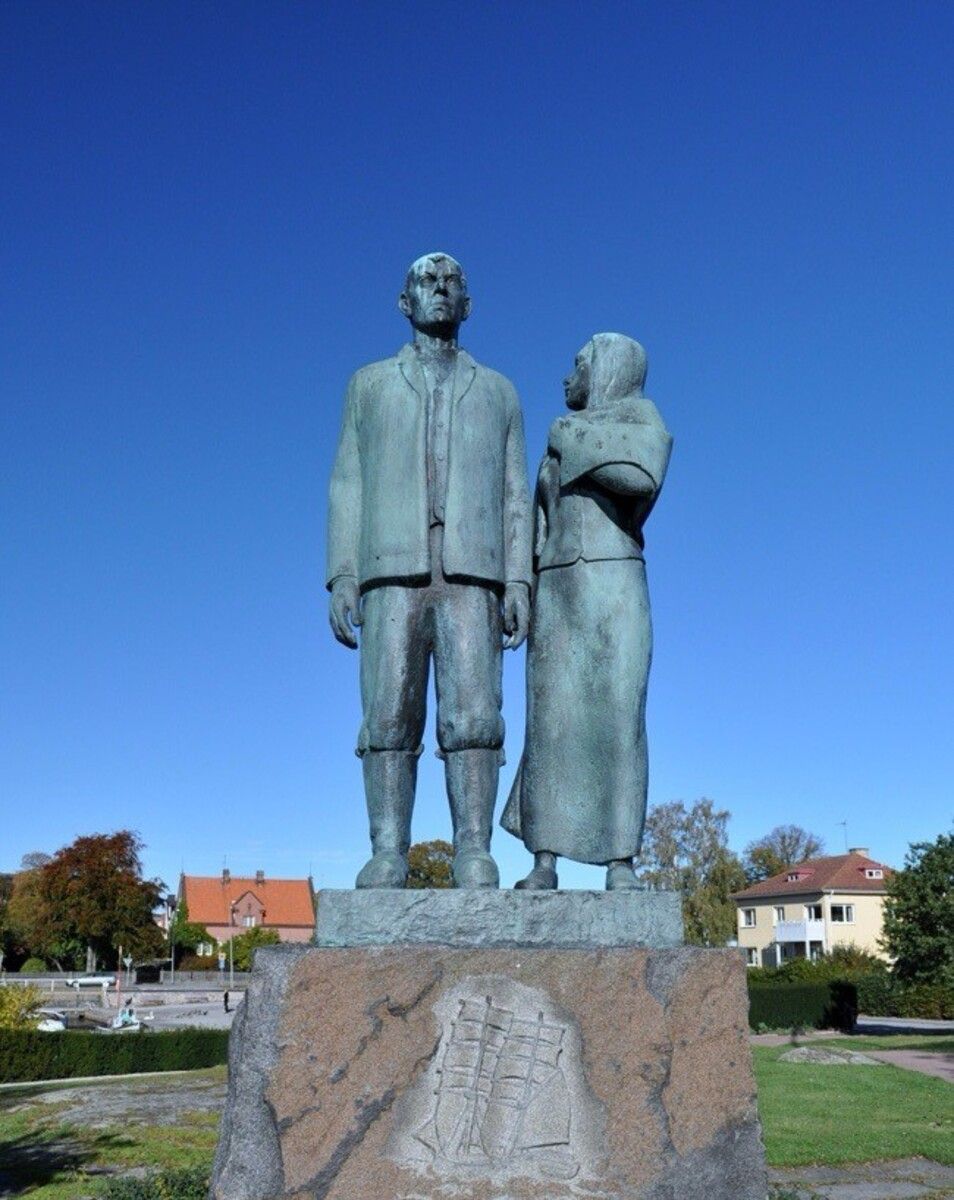
Vilhelm Moberg’s Utvandrarna (The Emigrants) begins its fictional exodus from Ljuder, a real parish in Småland. In his novel, Karl Oskar, Kristina, and their children leave their farm in Ljuder socken and embark on the risky journey to America.
Ljuder isn’t just a made-up name. It’s genuine Småland – i.e. Philip’s home. Moberg rooted many of his characters’ experiences in real geography, blending fact and fiction so closely that places like Korpamoen, Ljuder church, and Åkerby – as well as Chisago County and Taylors Falls in the U.S. – are very much real.
During the mass Swedish emigration of the 19th and early 20th centuries, over 1.2 million Swedes left for the United States. Many of them came from rural provinces like Småland, driven by economic hardship, thin soils, and hopes for a better life.
Just imagine their bravery. And hardships.
Have a wonderful weekend!
Philip & Hannes
Did you get this newsletter sent to you from someone you know? Click on the button below to subscribe for yourself. All you risk is to learn something new (perhaps even about yourself.)
Word of the week
förmiddag [FUHR-mee-dahg]
late morning, before noon.
“Farvel”: Sweden Fires Coach Jon Dahl Tomasson After World Cup Qualifying Collapse

Attribution: Omni
Sweden’s men’s national football team has officially parted ways with head coach Jon Dahl Tomasson after a disastrous start to the World Cup qualifiers. The Danish manager was dismissed on Tuesday following a 0–1 loss to Kosovo — Sweden’s second defeat to the same team in the campaign — leaving the nation with just one point from four matches.
“We’ve reached a point where the results simply aren’t good enough,” said football director Kim Källström in a statement from the Swedish Football Association (SvFF). Chairman Simon Åström added that while a playoff spot in March remains technically possible, the federation believes “new leadership” is needed to reignite Sweden’s World Cup hopes.
The pressure on Tomasson had been mounting for weeks. Fans booed the coach during Sweden’s recent home games against Switzerland and Kosovo, displaying banners reading “Resign, JDT” and other unflattering messages. This marks the first time in history that Sweden’s men’s team has fired a head coach mid-qualification.
Tomasson, who took over in March 2024, led Sweden through 18 matches with nine wins, two draws, and seven losses. His dismissal sparked immediate speculation about potential replacements — and one name stood out.
Former Östersunds FK and Premier League manager Graham Potter told Fotbollskanalen he would be open to the job. “I’m in Sweden right now, between jobs. Coaching the national team would be fantastic,” Potter said, adding that money wouldn’t be a deciding factor after his years in English football.
With two qualifying matches left — away to Switzerland and home against Slovenia in November — Sweden’s World Cup dreams now rest on who steps into the dugout next.
Postcard from the North

Örebro Slott
In other news
⛵ Experts estimate that there may be around 100,000 shipwrecks in the Baltic Sea, most of which remain uncharted. The brackish water prevents shipworms from destroying the wrecks, making the Baltic home to far more preserved ships than, for example, the North Sea. Several Nordic projects are currently working to map and document these wrecks more thoroughly.
🚨 Mikael “Greken” Ahlström Tenezos, the alleged leader of the Dalen crime network, has been extradited to Sweden after being arrested in Cancún, Mexico. He has been internationally wanted for several serious crimes, including attempted murder, weapons offenses, and drug smuggling. Swedish authorities describe his capture as a major step forward in ongoing investigations, noting that it is one of three significant arrests of top Swedish criminals abroad in the past week. He is also the second out of the three leaders of Sweden’s biggest crime networks to be arrested since this summer.
🚴♂️ After 400 days of cycling, Peter Ljungberg has completed his journey from Uppsala, Sweden, to Cape Town, South Africa. His adventure took him through 25 countries, averaging about five hours of cycling per day. Ljungberg mostly camped along the way but occasionally stayed in guesthouses, describing the experience as both challenging and deeply rewarding.
Swedish PM Threatens to Boycott SVT Debates After Chaotic Clash

Attribution: SVT Nyheter
Sweden’s Prime Minister Ulf Kristersson isn’t mincing words after Sunday night’s heated political debate on SVT — accusing the broadcaster of losing control and warning he may refuse to take part in future events.
The clash erupted during Agenda’s televised party leader debate, when Left Party leader Nooshi Dadgostar repeatedly interrupted other participants, prompting frustration from several opponents. Center Party leader Anna-Karin Hatt called her behavior “disrespectful,” while Kristersson described the debate as “childish, almost embarrassingly messy.” Speaking to SVT afterward, the prime minister said, “If someone can’t follow the rules, you might just have to turn off their microphone.”
Kristersson’s press chief, Siri Steijer, later emailed SVT, demanding they mute Dadgostar if she interrupts again — or risk losing the prime minister’s participation altogether. Kristersson added that he refuses to “be part of a shouting match” and criticized the format for rewarding “whoever yells the loudest.”
The backlash has drawn sharp responses. The Left Party’s communications chief Anna Herdy dismissed Kristersson’s comments as “ unserious,” arguing he should focus on healthcare backlogs, unemployment, and climate goals instead of TV squabbles. Meanwhile, Agenda’s executive producer, Michael Kucera, defended SVT’s approach, saying it’s up to the newsroom — not the government — to decide debate formats. “It would be a poor reflection of Swedish politics,” he said, “if we needed to cut people’s microphones for them to behave.”
Swede-ish Notes

Attribution: SVT Nyheter
A Resignation and a Reflection
After only five months as leader of Sweden’s Center Party, Anna-Karin Hatt announced her resignation this week — the shortest tenure of any party leader in Swedish history. Her decision, she explained, stemmed from the hate and threats that have increasingly come to define public life for many politicians. Hatt described living with a constant sense of unease, even at home, and concluded that the price of leadership had become too high.
The news shocked her party. But it also struck a chord beyond it. In a country that prides itself on civility and consensus, Hatt’s resignation is a sobering reminder that political life in Sweden is not immune to the toxic dynamics seen elsewhere. Many Swedes feel an extra layer of unease about political hate, shaped by the nation’s painful history — the assassinations of Prime Minister Olof Palme in 1986 and Foreign Minister Anna Lindh in 2003 still cast long shadows.
Still, it’s worth noting that Sweden’s political climate, though rougher than before, remains less polarized than many Swedes believe. Surveys show that while Swedes perceive growing division, ideological differences are smaller — and compromise more common — than in many democracies. The confusion may stem from where much of the debate now takes place: on X (formerly Twitter), where the loudest voices drown out the moderate middle.
As Swedish Radio’s Det politiska spelet recently pointed out, Swedes often imagine their politics as mirroring America’s — two entrenched sides locked in permanent conflict. The reality is more nuanced. Sweden’s tone may be hardening, but its democratic center still holds. The question now is whether it can remain strong enough to keep those willing to serve from turning away.
Do you have a story from the past that could be worth sharing? I bet you do! Or would you like to see something else in the newsletter and have suggestions for topics? If so, please reach out!
