
Good morning!
It’s Friday April 24.
Today in 1880, the expedition ship Vega sailed back into Stockholm after nearly two years at sea, greeted by cheering crowds and national celebration. Led by Adolf Erik Nordenskiöld, the expedition had achieved something no one before them had managed: navigating the entire Northeast Passage, the Arctic sea route along the northern coast of Eurasia.
What began as a scientific journey became one of Sweden’s greatest exploration triumphs. After being trapped in ice for months, just short of their goal, the crew eventually broke free and completed the route, effectively circling the entire Eurasian continent.
When Vega returned home on this day, Stockholm turned out in force. It wasn’t just a homecoming, it was a moment of national pride.
Ha en underbar helg!
Phil
Word of the week
UPPRYMD [OOP-rym-d]
elated; exhilarated.

A growing majority in Sweden’s parliament is backing the idea of setting a legal age limit for social media—signaling that tighter rules for young users may soon move from debate to reality.
Sweden may be on track to follow a global trend: putting guardrails on kids’ screen time. A new survey of parliamentary parties shows that six out of eight are open to introducing a legal age limit for social media platforms, marking a clear political shift toward regulation.
The idea isn’t entirely new. Prime Minister Ulf Kristersson has already floated a minimum age of 15, and the government has launched an official inquiry to assess whether such a rule is feasible. A first report is expected this summer—potentially setting the stage for legislation.
But while the political will is there, the “how” remains murky. Lawmakers are divided on enforcement: some point to digital ID solutions like BankID or future EU-wide systems to verify users’ ages, while others warn of privacy risks or technical loopholes.
And there’s a bigger wrinkle: even when rules exist, teens don’t always follow them. In Australia, where a 16-year age limit was recently introduced, early data suggests many young users are still finding ways to stay online—raising questions about whether bans can actually be enforced in practice.
For now, Sweden’s approach sits somewhere between ambition and uncertainty. The political consensus is forming—but turning that into a system that works in the real world may prove far more complicated than passing the law itself.
Postcard from the North

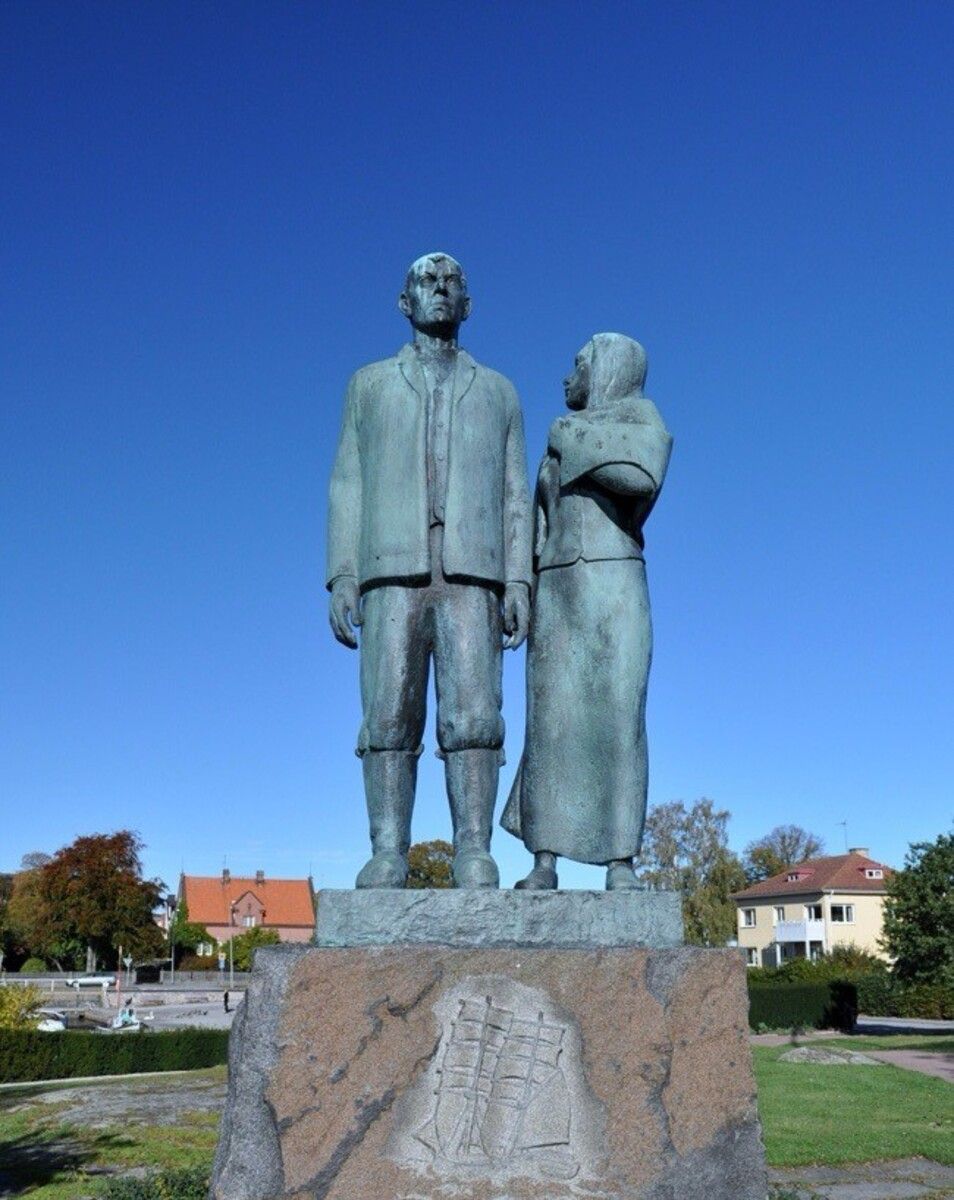
Ven, The Island
In other news
🪪 A new Verian poll reported by SVT shows historically large differences between how men and women vote in Sweden. About 64% of women support the red-green opposition bloc—the highest level since the 2022 election—while men still lean toward the governing Tidö parties. The gap is especially pronounced among young women, whereas support for the right is strongest among middle-aged men.
✈️ NATO aircraft are intercepting Russian planes over the Baltic Sea almost daily, according to military sources. The encounters typically take place in international airspace, where Russian aircraft often fly without transponders or clear identification. NATO says the operations are routine but reflect heightened tensions and increased Russian military activity in the region.
💸 Sweden’s Liberal Party leader Simona Mohamsson has come under scrutiny after it emerged she received payment for local political work in Gothenburg while working abroad, though she says she has repaid the money. In separate developments, a Left Party MP has formally left the party and will now sit in parliament as an independent “political wild card.” The live feed also highlights ongoing controversies and political tensions ahead of the 2026 election, reflecting a dynamic and sometimes turbulent campaign environment.
School Threat Shuts Down Swedish Classrooms—Then Leads Police to Missing Teen

A suspected school threat forced the closure of more than 20 schools in central Sweden this week—before authorities traced it back to a teenage boy who had already been reported missing.
What began as whispers among students quickly escalated into a full-scale shutdown. In the city of Borlänge, officials pulled the plug on classes across preschools, primary schools, and high schools after information surfaced about a potential act of serious violence.
Authorities didn’t take chances. Police described the situation as a credible threat involving a “serious crime,” prompting the municipality to activate emergency measures and keep thousands of students at home.
By midday, the situation took a sharp turn. Investigators located a teenage boy, previously the subject of a missing persons search, and brought him in for questioning. He was later detained on suspicion of making unlawful threats against a group, a charge often used in cases involving threats to public safety.
The arrest quickly defused the crisis. Authorities announced that the threat was no longer considered active, clearing the way for schools to reopen the following day. Prosecutors also emphasized that there is currently “no reason for concern” as the investigation continues.
Still, the incident leaves a lingering question: how a rumor circulating among students evolved into a citywide shutdown. For now, police are working to separate fact from speculation—while students and teachers return to classrooms that, just days earlier, had been abruptly emptied.
Swede-ish Notes

The Worst of Both Worlds: Stagflation?
There is a word that has started to surface again in Swedish economic reporting. It is not a comforting one.
Stagflation.
When Erik Thedéen, governor of Sveriges Riksbank, says that Sweden is moving “in that direction,” it is not meant as a headline grabber. It is more of a warning label. Stagflation is the economic equivalent of having both the brakes and the accelerator pressed at the same time: rising prices, but little or no growth.
The backdrop matters. The government recently acknowledged that the economic impact of the war involving Iran, Israel and the United States has gone from “limited” to “tangible” for Sweden. Energy prices, fertilizers, transport costs, all the invisible threads that tie a small open economy to the wider world, are pulling in the wrong direction at once.
At the same time, the political messaging remains cautiously optimistic. Budgets are presented, confidence is invoked, and recovery is described as something just around the corner. Both things can be true, at least for a while.
But stagflation, if it takes hold, is awkward precisely because it resists easy solutions. Raise interest rates, and you risk choking off growth. Lower them, and inflation may take off again. It is, as Thedéen put it, something of a “mardröm” for a central bank.
Perhaps what stands out most is not the numbers themselves, but the shift in tone. Not long ago, the question was how quickly Sweden would recover. Now, it is whether the recovery and the price pressure can coexist.
It is a subtle change. But in economics, subtle shifts are often the ones that matter most.
Do you have a story from the past that could be worth sharing? Or would you like to leave a suggestion? Please reach out!
